9/27/2012
 |
| The Kending wind turbines |
To follow up
my review of the scathing criticism of wind power that is Windfall, I took my new 60D Canon and headed down to sunny Kending to get a first hand view of wind turbines in all their terrible glory.
Windfall claimed that the noise of the wind turbines drove people crazy; drastically affecting sleep patterns and having a deleterious impact on the general health of local residents. Despite first hand experiences of this "Wind Turbine Syndrome" in the documentary being limited to just a few people in a small town in upstate New York, the argument that windmills drive people Don Quixote left and right ended up as a bit of he-said-she-said without a clear way to prove the hearsay coming from either direction.
Wind and Its Enemies
The plight of the residents of Meredith, NY is quite common. My google alerts constantly update me with more and more examples of towns in an uproar over wind companies vying for a piece of their land. Searches pull up a mix of opinions and "facts" about wind power, creating the impression that there is an equivalency between the validity of pro- and anti- wind arguments. The one test that this equivalency fails is the money test. Who has the most to gain by wind power's failure? Who has the most to gain by its success? The easy answer is the fossil fuel companies and the wind companies, respectively. What seems to skew this equivalency the most is the sheer size, influence, and power of traditional fuel companies, giving them a stronger monetary incentive to skew the truth as well as a mountain of funding to create doubt around the wind industry and drum up populist resistance to turbines.
 |
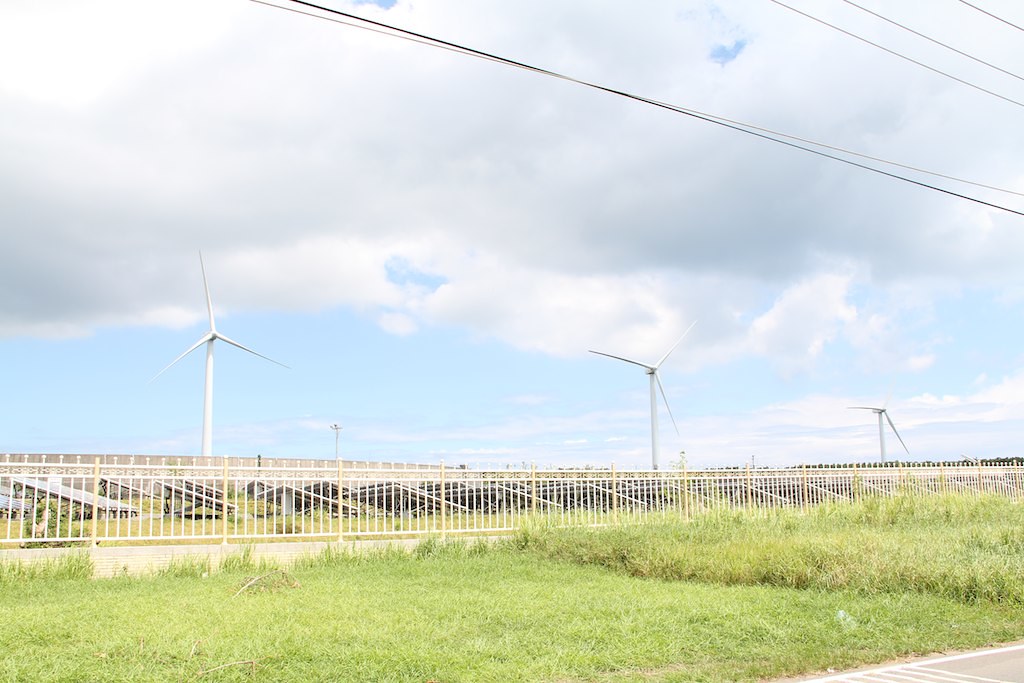
| The turbines in Kending are enclosed within the restricted area surrounding the Nuclear Plant #3, letting me take foreboding shots of them behind barbed wire |
The turbines in Kending are standing 65m high, spin 35m blades[
1], and have a 4.5 MW total capacity between 3 identical 1.5MW towers. Along with a smallish solar installation, they are located within the restricted area surrounding Taiwan's third nuclear power plant (out of a total of four island-wide), unfortunately limiting my access. However, I was able to drive a neat semi-circle around the turbines at close distance.
Windfall had a number of claims damning wind turbines such as these (ones dealt with in this article highlighted in bold):
- 120+ meter tall turbines are monstrous eyesores
- A repetitive "whomp" sound drives people crazy
- The shadow of a turbine on a house creates a "shadow flicker", also driving people crazy
- Thousands of birds are killed each year
- Bats are killed as well
- Turbines occasionally catch on fire and throw off big chunks of ice
- It doesn't actually reduce reliance on fossil fuels because wind power's intermittent nature requires constant backup from coal or gas plants
- Wind turbine syndrome causes insomnia, headaches, and various other stress-related health problems- Wind power companies are predatory corporations that take advantage of poor country folk
 |
When I got within view of the turbines, one of wind's actual shortfalls was apparent:
there was little wind and the turbines were stopped (one did rotate to face the other way). |
A Quick Look at "Setbacks"
 |
The Taipower museum dedicated to energy production in Taiwan has a
few interesting, if decidedly gimmicky, items: a slick solar overhang and
a small 1.2kW concentrated solar panel. |
After looking around the small museum on site dedicated to power production in Taiwan, I drove back around the turbines, stopping and asking anybody I saw that looked like they spent every day outside, such as road-side stand vendors or outdoor security guards, who would be within ear-shot of the cacophony that I had heard so much about.
Measuring with Google Maps, the places where I interviewed locals were between 430m at the closest point and 880m at the farthest point away from the turbines.
The flags represent the wind turbines and the selected locations are where I spoke to locals. Zoom out 3 times to see the whole map.
To get perspective on this, here are some minimum legal "setbacks", the distance from wind turbines to the closest residences, from around the world:
NY State, USA:
760m from residences [2]
490m from property lines [2]
Ontario, Canada: (smaller turbines)
550m
(larger turbines)
1500m
Wales, UK:
500m (current suggested)
1km (smaller turbines) (
part of a bill being considered[3])[
4]
3km (larger turbines) (
part of a bill being considered[3])[
4]
UK:
350m (current suggested)
1km (smaller turbines) (
part of a bill being considered[3])[
4]
3km (larger turbines) (
part of a bill being considered[3])[
4]
Denmark: 4 x turbine height (
260m in this case)
Germany: “quiet regions” [35 dB(A)]:
1,000-1,500m
“middle regions” [(40 dB(A)]:
600-1,000m
“standard region” [(45 dB(A)]:
300-600m
The laws are often convoluted and different in many parts of each country. Here is a more extensive list[5] of setbacks in Europe.
 |
Kending offers the most spectacular beaches and ocean views in Taiwan, right around the corner from
the wind turbines |
The Voice of the People: Meredith, NY vs. Kending, Taiwan
I spoke to people at 6 different locations around the turbines and almost everybody's immediate answer to "Can you hear the sound of the wind turbines when they are moving?" was an unequivocal "No". When I pried further, some people said they could hear them at night, but the sound was very subtle.
"Is it as loud as road noise?"
"No, not nearly that loud."
"Does it affect your sleep? Does it wake you up? Prevent you from sleeping?"
"No."
"Does it affect your life in any way?"
"No, not at all."
"Has anybody complained about the wind turbines at all since they were built or before?"
"No."
One person made a good point mentioning that when the wind picks up and the turbines move faster, you still can't hear them because of the additional noise of the wind itself.
Windfall's claims of "Wind Turbine Syndrome", a medical condition still yet to be proven by any medical society
[6], didn't have any backing among this community at all. One would assume there would be at least a small minority of people negatively impacted and the community would have some sort of inkling of this. However, it seems there had been no protests or complaints whatsoever.
 |
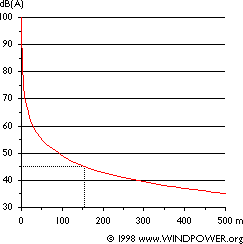
| 90m high wind turbines produce noise levels between conversation and whispering at 300m away[7] |
Another item of note was that many people seemed slightly bewildered by my questions and were curious why I was asking. It was as if they had never had this conversation before and had never even considered these issues. A few people mentioned that there have been protests against the nuclear plant, which has now been running for about 26 years now, but nobody had ever had a problem with the wind turbines.
Predatory Practices
 |
West Texas certainly looks like it's "enjoying" wind power. Even the
biggest proponents of wind wouldn't wish this on their worst enemy. |
The situation in Taiwan is very different than in NY state. The wind turbines were set up by Taiwan's government-run Taipower company, and were also built on the property of the local nuclear power plant. This eliminates a lot of the profit-seeking incentives that would guide predatory practices in this industry and building them on government owned land completely removes the conversation about compensation.
There's really not a good direct comparison to make here, but it's interesting to note that removing the profit motive may have a positive effect on local communities. On the other hand, Taiwan's power production is overwhelmingly and increasingly dominated by dirty or nuclear energy and a profit motive might be just the thing to turn that trend around.
 |
Taiwan's energy distribution by year according to Taipower; natural gas and coal are on the rise.
I apologize for the low quality, but I haven't been able to find this online.
The years are Taiwan years, so normal years minus 11. Year 97 = 2008 |
Red: Nuclear
Dark purple: Oil
Blue: Coal
Tan: Natural Gas
Maroon: Cogeneration (energy produced from excess heat in various installations)
Light Purple: Hydroelectric and renewable sources, a vast majority of which comes from hydro
Why Windfall Might Be Wrong
Everyone I spoke to was completely bewildered by the fact that anyone was investigating turbine noise or other externalities to such an extent that it was obvious they had absolutely no effect on their lives at all. The distances from the turbines at which I spoke with locals were smaller than many international legal or recommended setbacks, making it seem like this is within the range of comparison.
Why Windfall Might Be Right
 |
Larger wind turbines today are about 3MW and 100 meters tall.
The Kending turbines are the size of the 1.5MW turbine shown above |
Although the turbines seem huge in person, they only stand half the height of some of the highest turbines, including the ones discussed in
Windfall. Although the legal setbacks mentioned in
Windfall were 760m from residences and 490m from the property line, there was an example of 320m in the 195 wind turbine installation in Tug Hill, making the distances in Kending with a much smaller installation seem positively generous.
Reading up around the web, it seems that many of these international legal and recommended setbacks are based on simple decible levels, not accounting for inaudible frequencies that may have an effect on people's health
[8]. There is also the claim that only 15% of local residents will feel "Wind Turbine Syndrome" caused by infrasound, and only 3% will have more pronounced symptoms like sleeplessness and anxiety
[9], making it possible that my rounds in the community missed these victims or they have been misdiagnosed by local doctors, pointing the finger in other directions.
There is also the fact that this theory of anti-wind groups spreading falsehoods throughout communities about wind power is still just a conspiracy theory at present, and conspiracy theories should be mistrusted by their very nature. That said, the scientific community seems to lean towards the argument that these claims about wind's local effects are baseless, bringing to mind the false equivalency of climate change; with science coming down on one side of the argument and big moneyed interests coming down on the other.
Conclusion
This does not prove that wind power does or doesn't cause health problems and general disruption to the lives of locals. However, it is an example of medium sized turbines that, at a reasonable distance from local residents, cause no negative impact to the community whatsoever.
Moving forward I will continue visiting these sites to see if I can find some examples of locals effected by wind turbines; whether it be from larger turbines, larger installations with more turbines, turbines placed closer to residences, or just a lucky find.
 |
| The wind howling its displeasure |
References
[1]http://news.chinatimes.com/focus/11050105/112012042900320.html
[2] Windfall, 2012
[3] http://www.publications.parliament.uk/pa/bills/lbill/2012-2013/0011/13011.pdf
[4] http://www.pinsentmasons.com/en/media/dco-news/may-2012/23-may-2012/wind-turbines-minimum-distance-from-residential-premises-bill-2012-receives-first-reading-in-the-house-of-lords/
[5] http://www.wind-watch.org/documents/european-setbacks-minimum-distance-between-wind-turbines-and-habitations/